
Photo courtesy of Peter Stubbs.
In the South West
of the city of Edinburgh lies the refined and predominantly
residential area of Morningside. With an eclectic collection
of small traditional shops, schools, bakeries, restaurants,
a library, a hospital – The
Royal Edinburgh - and noted Edinburgh pubs as well as larger
chain-store supermarkets such as Marks and Spencer and Waitrose,
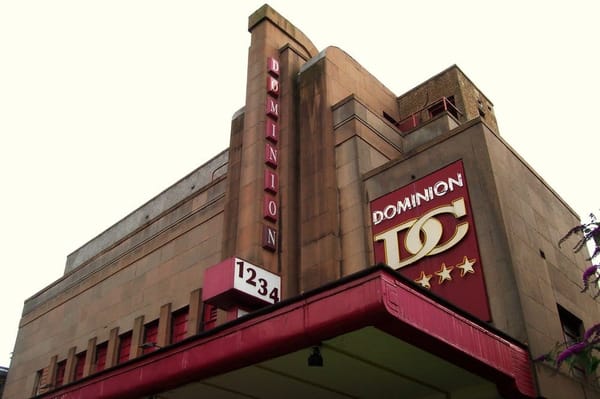
this area even boasts a family-run cinema, The Dominion,
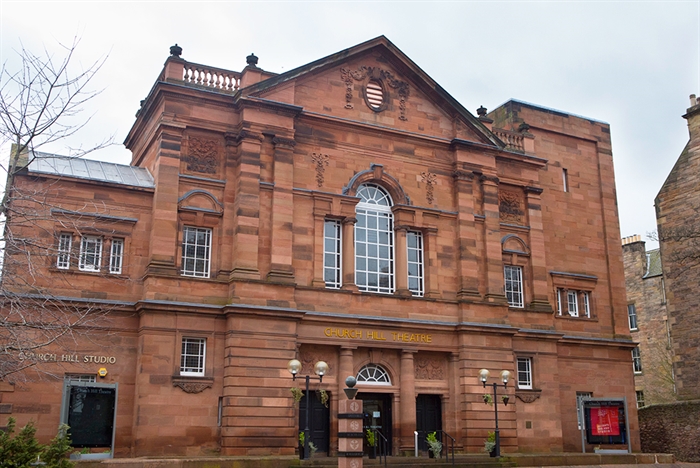
and the locally acclaimed Church Hill Theatre.
In short, Morningside has much to offer both its residents
and visitors.
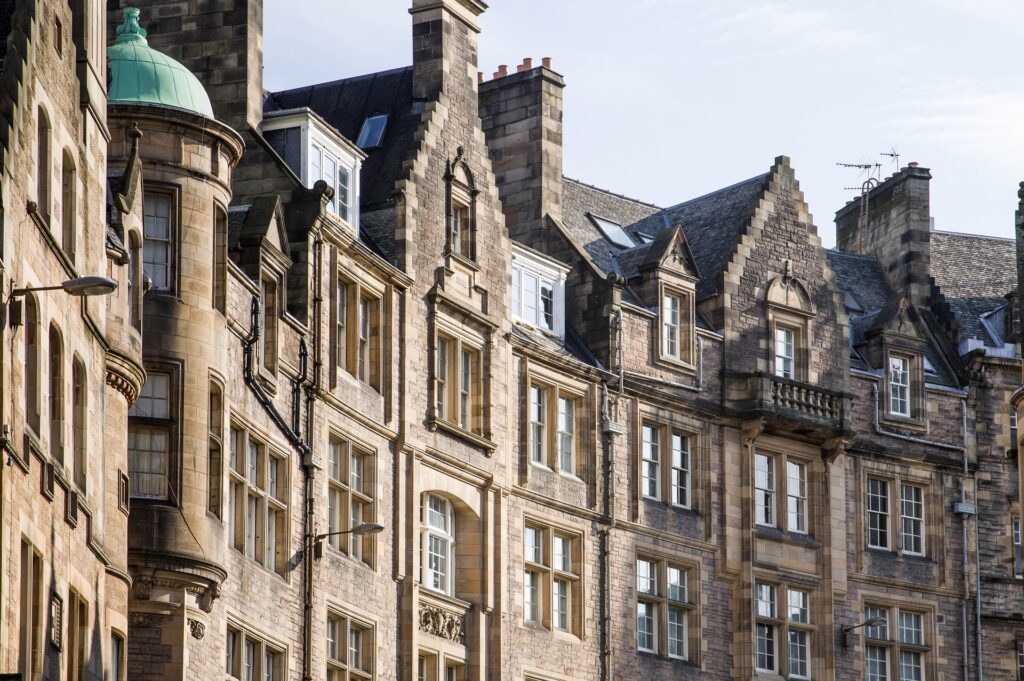
Running through the heart of the area itself is the long
and winding Morningside Road - an ancient route from Edinburgh
to the South West. Georgian tenement-style housing flanks
this road on both sides however there are also many Victorian
villas dotted throughout Morningside as well as other notable
buildings of architectural interest.
On the boundary of neighbouring Bruntisfield and Morningside,
at the crossroads where Morningside Road, Colinton Road and
Chamberlain Road meet, lies Holy Corner, the nickname given
to the area where four churches historically lined each corner.
Three of these churches remain to this day – Christ
Church (the Scottish Episcopal Church), Morningside Baptist
Church and Morningside United (The Church of Scotland and
United Reform Church, which merged in the late 1980’s)
The fourth church, Morningside North Parish Church became
the Eric Liddell Centre in 1980, home to the Christian charity
named after the famous Scottish athlete whose life was portrayed
in the 1981 Oscar winning film “Chariots of Fire”.
The area’s “holiness” has been further
enhanced in recent years with the addition of an Iyengar
Yoga Centre, a Christian Healing Centre and, until 2005,
the Edinburgh base of the Western Buddhist Order resided
in Morningside.
A short distance from Holy Corner, on Morningside’s
Church Hill, there is The Church Hill Theatre, which was
originally Morningside Free Church and like Christ Church,
was built by the Edinburgh architect Hippolyte Blanc (1844 – 1917),
renowned for his buildings in the Gothic revival style.
Religion appears to be a running theme in Morningside as
many of the street names have Biblical connections. Canaan
Lane, Eden Lane, Nile Lane and Jordan Lane are but a few
and also running under Morningside there is the similarly
named waterway Jordan Burn.
The Morningside Clock is a celebrated landmark which originally
stood in the middle of the road as the clock for Morningside
Railway Station, opened in 1884 and closed to passengers
in 1962. The line is used only for rail freight these days
although diverted passenger trains can still occasionally
pass through Morningside. Although the station itself has
gone, its entrance remains and is now home to a branch of
the Bank of Scotland
.
The family-run Dominion Cinema on Newbattle Terrace is a
perfect example of “Streamline Moderne” art deco
architecture. The site was bought in 1937 by Edinburgh businessman
Captain W.M. Cameron and within 16 weeks the cinema was built.
Now the Dominion with its mere 4 screens comfortably competes
with large multiplexes due to the opulence of its interior
and the stress given by the owners to patrons on the pleasure
of the cinematic experience.
Culturally Morningside has always been a literary haven for
writers of note. Famed Scottish authors Alexander McCall
Smith and Ian Rankin live in the nearby Merchiston area as
does Harry Potter creator J.K. Rowling. The author Dame Muriel
Spark (1819 – 2006)
also famously brought the area to life in her 1961 book “The
Prime of Miss Jean Brodie”, by having the eponymous
heroine reside in Morningside.
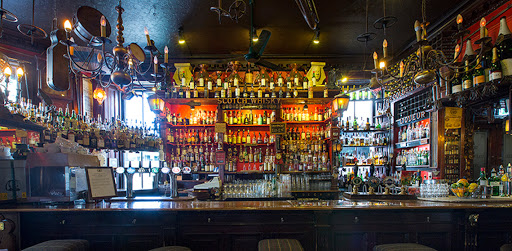
No description of Morningside would be complete without mention
of the Morningside Road pub, The Canny Mans. An institution
since Victorian days (1871) this is a pub that is filled
with not only old world charm but a renowned collection of
paraphernalia – old clocks, paintings, Chinese umbrellas,
musical instruments and mannequins. With fine wines and hundreds
of single malt whiskies to sample, The Canny Mans is one
of Scotland most famous pubs and is a must when visiting
the area.
|